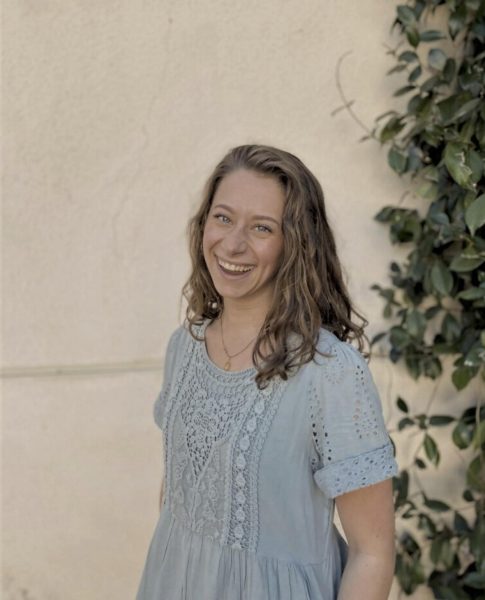
The Mother of Divine Grace curriculum has been set up in a way that not only prepares its students for college but also prepares them for life. It equips them with the knowledge needed to graduate high school but also the faith and understanding of the Catholic Church. In order to fully understand and appreciate this, who better to tell us the benefits of not only MODG but also TAC then a fellow graduate from both and currently an LS teacher for MODG, Ms. Anna Santine!
- As a graduate of MODG, how was it navigating college, especially attending Thomas Aquinas College (TAC)? Did you have a disadvantage or did the curriculum line up?
“I feel that MODG prepared me well for attending TAC, particularly because both MODG and TAC provide a classical approach to education. For some specific examples, my MODG education prepared me for the high volume of reading, Latin classes, and writing (I’m really grateful for how the MODG writing progression equipped me, especially!). MODG also played a large part in my interest in TAC, since it formed me to see the value in liberal education in the first place!”
- Was it easy to secure a job with a degree from a liberal arts college?
“I’m very fortunate that I didn’t experience difficulty in securing a job with a Liberal Arts degree. It is true that a liberal education forms the mind and prepares graduates to pursue a wide variety of jobs, although many of those pursuits would require further education. In my case, I had an interest in teaching, and my education set me up well for that right away!”
- How do you think MODG has changed since you were a student and what were some of your favorite things about being a student?
“In the most fundamental ways, MODG has stayed the same since I was a student, which is wonderful to see. There are some little changes, though — little adjustments in the syllabi, particular books used for LS classes, or LS classes offered, for example. Probably the main differences I see are in external challenges that were minimal or non-existent in earlier years, such as the pushing, advertising, and integration of AI on so many platforms. That can pose quite an obstacle to both learning and teaching, and it was really not even a consideration when I was in high school (at least as far as I was aware!). On a lighter note, another minor change in MODG since I was a student is the use of Zoom for LS classes! When I was in LS, we used different software, and tech problems were pretty frequent! Some time after I graduated, MODG made the switch to Zoom, and it’s been wild to see the difference. Tech issues don’t get in the way of class nearly as much now, and if any arise, they are usually easily remedied!”
- What was the most surprising thing you realized about the school once you saw it from ‘the other side’ of the teacher’s desk?
“To be honest, there were not too many surprising things about seeing MODG “from the other side.” Since I was enrolled as a student in MODG K-12, I was already familiar with the values, methodology, classes, and curriculum of the school, so it felt natural returning to the school as a teacher. I will say, though, it has been eye-opening to see the dedication, intentionality, creativity, planning, and efforts of MODG staff and teachers more closely behind the scenes. Everything is ordered toward supporting MODG families, and every decision is made with the best interest of the students in mind. Witnessing and participating in that has not exactly been surprising, I suppose, but it is something I didn’t really think about much as a student, and it is beautiful to see!”
- What is some advice that you would give someone who was considering applying to TAC?
“I absolutely loved my experience at TAC and wouldn’t change those formative years for anything. At the same time, it’s not a perfect fit for everyone! If someone is considering applying to TAC, for a start, I would advise poking around the TAC website. I’d encourage the reading of the “A Liberating Education” section. That will give a good overview of the curriculum and the intention behind it. In the same section of the website, I’d particularly suggest reading “An Education for its Own Sake” and “Program Objectives.” The universal major can be a hurdle for a lot of people, since it seems impractical and is not a set-up for a specific job. At TAC, though, the education is not simply ordered to a career/practical skills, because the truth is good in itself and knowledge of it is worth pursuing for its own sake.
Although many graduates begin working straight after college, a large number also goes on to grad school to study law, medicine, philosophy, engineering, etc. So, if there is a targeted discipline someone wants to pursue someday, it’s important to keep in mind that attending TAC could multiply his/her years of education, since further schooling would be needed afterward in many cases. Some will see value in that, others will not. For that reason, I think it’s important for someone to seriously consider what he/she is hoping to get out of a college education (e.g. Does he/she value the intellectual life? Is he/she drawn to the Great Books? Does he/she have interest in the Socratic discussion method? etc.). Lastly, if it is at all possible to visit the TAC campus and sit in on some classes, I’d highly recommend doing that!”