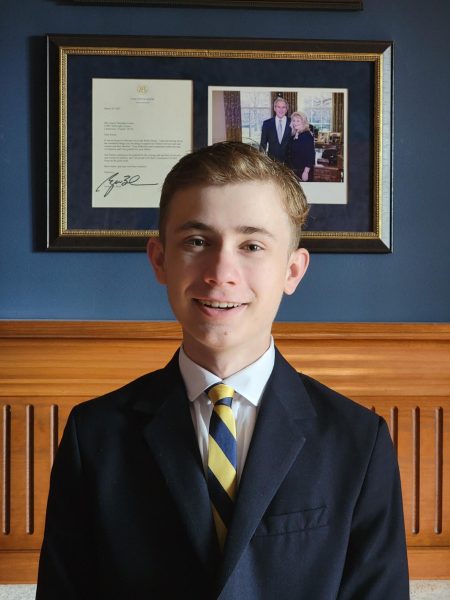
In the fall of 2024, I had the pleasure of re-connecting and conducting an interview with my talented friend, Maclain Conlin. Maclain is a high school senior living in North Carolina. He has competed in speech and debate through the National Christian Forensics and Communication Association (NCFCA) and won several national awards. He has also won Moot Court competitions with the National Association of Moot Court (NAMC) at Duke and Yale and in 2023, his team placed second in the nation overall for Moot Court. During the summer of 2024, he served as an intern for Justice Trey Allen of the North Carolina Supreme Court. Presently, Maclain is the Managing Editor of Originalist Angles, a national law review for high school students, and he frequently writes about legal history for The Carolina Journal, a statewide NC publication. In the recent past, he won the Princeton Legal Journal’s International Essay Competition and his paper was published in the PLJ.
Touching briefly on the high school law review, Originalist Angles (OA), we discussed its purpose and scope. Run by high school students, OA was founded in 2022. It is quite unique, and one of the few publications in the country whose purpose is to give high schoolers an opportunity to engage with law, particularly through debate and research.
Its board of advisors includes a number of law professors from top law schools around the country, including Dr. Randy Barnett of Georgetown University, who according to Maclain, is “one of the greatest originalist legal scholars in America.” Moreover, Maclain has interviewed numerous legal scholars for OA, including Judge Paul Matey of the Third Circuit Court of Appeals, Commissioner Nathan Simington of the FCC, and Professor Michael Munger of Duke University, along with many others.
For readers who may not be familiar with the definition of “Originalism,” Maclain explained it as “a method of interpreting the Constitution where you look at how its words were interpreted at the time the Constitution was enacted. In other words, we believe the Constitution means what it meant when it was first enacted by the American people.” However, not all the articles published on OA have to advocate the originalist view point. OA encourages a “great deal of debate.” I also promised Maclain that I would mention OA’s Open Application for new writers. If any of our readers here at MoDGNews are interested in getting more involved in subjects like these, Maclain invites them to let him know! “We would love to hear from you, and I want to emphasize that you do not need to have any prior legal experience to apply. We encourage as many students as possible to reach out, and we look forward to having another great year. We want this to be an elite publication that will span decades and have a great influence on young people.” (You can reach him at [email protected])
Maclain’s greatest goal in life is to be a Federal Appellate Judge. He is well on his way, with his study of constitutional law, internship with Justice Allen, and Managing Editorship of OA.
But before all that— I met Maclain while we were both competitors in NCFCA, so I asked him how he thought Speech, Debate and Moot Court prepared him for his current interests. “There are a number of ways,” he replied. “In elementary school I was extremely shy and I didn’t really like to say much. I think Speech and Debate has done a great deal to bring me out of my shell and teach me how to communicate effectively with others. I also think it’s taught me the importance of honing your writing skills.”
Competing in Moot Court is particularly relevant to Maclain and his future law profession. “In Moot Court, you are given a kind of case that the Supreme Court would actually hear, and then you’re allowed to write and present an argument as if you were an actual attorney, and then take questions from real attorneys and real law professors.” Moot Court is an opportunity for Maclain to put into practice the topics he’s studying. He noted that it not only taught him the basics of writing properly (how to cite correctly in a legal document, etc.), but also how to answer questions on the spot.
Maclain said that there are three main skills he has learned from Moot Court. These skills are useful for anybody, whether they plan to go into a legal career or not.
First, as mentioned above, the ability to answer questions on the spot. “Most of life is not scripted,” he pointed out. “Every single person will probably be in a job interview at some point and be asked a question that they had not anticipated. Moot Court helps you to answer those kinds of questions.”
Second, he values the skill of writing concisely and effectively. For Moot Court, “You’re in a very, very tight space. You have to write a very short legal document called a brief, and then when you’re actually arguing, you’re constantly getting interrupted with questions, so you need to be quick.”
Third, another important skill is “the ability to disagree with others while also listening carefully to the arguments that your opponents make.” Moot Court is a “very polite and very courteous kind of debate. In other kinds of debate, you can get a little more bombastic and fiery, and you can be really passionate. In Moot Court, it’s not that you aren’t passionate, but there is greater decorum and structure.”
I think this is an important lesson for many people to learn nowadays–that in all debates, we should listen respectfully to our opponents’ views and do our best to understand them. They could also have a good point of view, and your job is not to make them look foolish, or to put them down, but rather to simply explain why, based on the available evidence, your position is better.
Beginning in 2022 at a tournament hosted by Yale University, Maclain has competed in the National Association of Moot Court, a new league for high schoolers. He has had two partners and he has participated in a number of tournaments and won several awards, including second place team in the nation, and third place speaker this past season. For more information, I recommend Maclain’s interview with Matthew Meyers, a co-founder of NAMC and the former President of Yale University’s Undergraduate Moot Court Program.
I also asked Maclain if there were any current issues or topics that he thought it important for high schoolers to follow. “Definitely,” he replied. More high schoolers need to be aware of “how important the separation of powers is for protecting our freedom. Very often we think of the Separation of Powers as a procedural thing that you just have to get through to get your policy enacted.” Government power is not centered upon one person or branch, but spread among the three branches. Maclain explained this topic so eloquently that I will put his words here in full.
Like for example, the sixty votes rule in the Senate with the filibuster. We think of that as simply holding us back, and it’s kind of a relic and most people don’t like it. But what it does is it forces all Americans to compromise and recognize that we live in a large country with very diverse views, and that before we put something into law (perhaps permanently), it has to first gain a consensus. But beyond that, the separation of powers also makes it very difficult for any one person to accumulate too much power and abuse it. And it also ensures that, when the people do ultimately make a decision, that decision is respected by the other branches.
Now, just to take one example of this, there’s a legal doctrine called sovereign immunity that you will hear criticized very, very much (it’s a very unpopular legal doctrine). [It says] basically you cannot sue the government, unless the law says you can. Most people don’t like this because they think it’s unfair, and there are some edge cases where it probably is unfair, but the reason why I think it’s still a good doctrine overall is that when you sue the government and you get a court order to stop public officials from doing something, an unelected court is overriding the will of our elected representatives. Sovereign immunity protects democracy by ensuring that our elected officials cannot be overruled by unelected judges unless the people have enacted a statute (or constitutional provision) which specifically allows courts to do so.
So even these really complicated, unpopular legal doctrines like sovereign immunity may be more important than we realize. What they’re really about is preserving American freedom and the ability to make decisions through our elected officials. We’re a democracy, not an oligarchy, and I think that doctrines like the separation of powers reflect that. That’s why they’re so important.
I asked whether some people might consider sovereign immunity as an abridgment of freedom instead of a sanction of freedom. He offered the following reply:
Many people do argue that we should get rid of sovereign immunity for that reason, but I don’t think that’s a great idea, because we do have a federal law in place called Section 1983 that specifically says, when your federal rights are violated, you can sue the government for redress. Now, people might disagree about how to interpret Section 1983 in particular cases but I think it does show that when our rights are on the line, Congress and state legislatures do act to protect them.
The idea behind sovereign immunity is that unless you have something in writing saying that the will of the people will be limited, it still belongs with the people’s elected representatives to make that decision. I think that makes perfect sense, and it plays an incredibly important role in ensuring that our rights are protected through the courts, while also ensuring that the people’s elected representatives make the vast majority of decisions. They’re elected, and courts are not.
“And that’s their job,” I noted.
Precisely. It seems so basic, yet many people forget it: it’s Congress’s job to make laws, the President’s job to decide how to enforce them, and the courts’ job to interpret those laws, and whenever any of those three branches start stepping outside their boundaries, even in the name of doing good, it will inevitably destroy freedom. That’s why our Founders were so brilliant to separate power, in order to ensure that.
Because the Founders were religious people, they recognized the Fall of Man and Original Sin. And they recognized that if you gave any one person or any one branch too much power, they would inevitably abuse it.
Naturally, not everyone is called to a legal career, but Maclain and I still recommend doing speech and debate, Moot Court or some form of forensics because of the valuable skills which apply in any career. But for students who are thinking about going into law specifically, Maclain mentioned two things which really intrigued him.
First, the ability to argue and debate great ideas is central to the law profession. “If you are a person who enjoys having discussions about foundational issues then law or politics are probably the only two areas where you’ll get to do that on a daily basis.”
Second, he pointed out that law is, “in a way, the closest job you can have to being a philosopher outside of academia. Because philosophy is about discussing the great issues that underlie all other topics, and law really does delve into that.”
One thing I’d like to point out too is that Justice Antonin Scalia, who is widely considered one of the greatest Supreme Court Justices of the last fifty years, majored in philosophy and frequently quoted classical authors, including Aristotle and Aquinas (as well as the great texts of Roman Law), in his opinions and writings. Scalia believed that if you don’t have a knowledge of great ideas and the Great Books, you can be a good lawyer, but you’ll never be a great lawyer.
Maclain Conlin will be a great lawyer, and I am grateful for the opportunity to share his wisdom with all our readers here on modgnews.com.