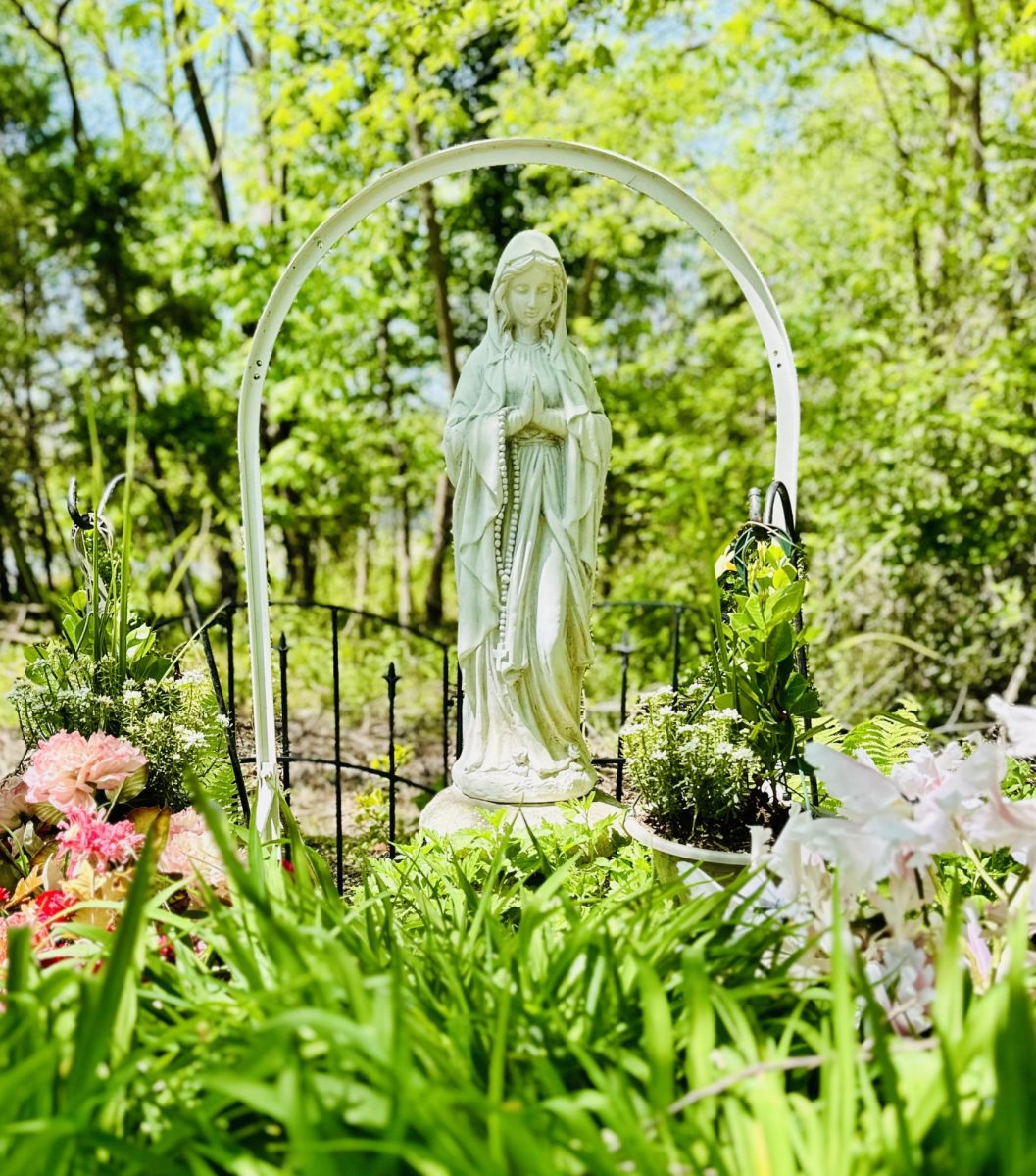
May is almost here! For many of us, May heralds the end of the school year and beginning of summer fun. However, May is also the month dedicated to the Blessed Virgin Mary. An engaging, Catholic way of celebrating Our Lady’s month while also embracing God’s creation is to plant a Mary Garden!
A Mary Garden is a garden that contains flowers, herbs, and other plants that are named after Mary and Jesus. These plants remind us of Our Lady and help us honor her.
The earliest Mary Garden was created by the 7th century Irish Saint Fiacre. The tradition of naming flowers after Our Lord, Our Lady, and the saints dates back even farther to the first centuries. In medieval times, the Church gave common flowers symbolic names to teach uneducated people about the Faith.
Mary Gardens are a beautiful Catholic tradition that honors Mary and glorifies God’s Creation, while simultaneously prompting us to spend more time meditating on Our Lady and the mysteries of her life. Mary Gardens are a perfect place for prayer. For example, you can pray while you garden, or set up the Stations of the Cross throughout the garden. Being surrounded by these symbolic reminders of Mary and Jesus is good for the soul!
To make it easy for you, I have compiled a list of 10 common flowers and herbs that are named after Mary and are easy to incorporate into your very own Mary Garden!
Remember, a Mary Garden does not have to be complicated or take up your entire backyard; it can be as simple as a few of these flowers in a pot on a balcony. Our Lady and Our Lord love all of our human efforts to glorify God!
1. Baby’s Breath
Everyone knows and loves these tiny white flowers that look like lace; hence their symbolic name, Our Lady’s Veil. This tough, herbaceous perennial plant thrives in a variety of soils and climates. It blooms summer through fall and is a popular addition to any bouquet.
2. Forget-Me-Nots
These sweet little flowers are typically blue, which is why they are called, Our Lady’s Eyes. These hardy flowers thrive in wet, shady environments, and rarely succumb to pests or diseases. Depending on the species, they can be annuals or perennials.
3. Marigolds
These stunning golden blossoms merit their traditional name, Mary’s Gold. They are easy to care for, and they are also known to repel pests! These edible flowers are rich in minerals, and because of this they can be used for natural remedies or to garnish a dish. Marigolds bloom from spring to fall and thrive in warm climates.
4. Lilies-of-the-Valley
These charming flowers look like bell shaped pendants, and are called Mary’s Tears. They can survive a variety of climates and bloom in the spring. However, these sweet smelling flowers are poisonous, so be sure to plant them away from children and pets.
5. Cornflowers
This stunningly blue flower is called Mary’s Crown. These easy-to-grow, annual flowers can survive anywhere, and the papery flower heads attract butterflies. Because of their intense blue color, Cornflowers can also be used as a dye.
6. Violet
Modestly popular violets are a favorite because of their simplicity. They symbolize Our Lady’s Modesty. Violets typically grow in shady, wet, areas, such as forests. They can be annual or perennial, and they bloom in early spring.
7. Morning Glories
The Heavenly Blue variety of Morning Glories is called Our Lady’s Mantle because of its rich blue color and full petals. This twining flower grows quickly and is perfect for covering a trellis. Depending on the climate, morning glories can be annual or perennial, and tend to bloom in the summer.
8. Iris
Irises are a uniquely gorgeous addition to any garden. They are called Mary’s Sword of Sorrow because of their sword-shaped leaves, symbolizing the swords that pierced Mary’s heart. The fleur-de-lis, another symbol of Mary, is a stylized iris. There is a wide variety of irises, but they usually in the spring.
9. Rosemary
This common herb is already named after Mary, but its Medieval name is Mary’s Nosegay. Rosemary flowers have a variety of colors: pink, blue, white, and purple. Rosemary is easy to cultivate in a pot or in a garden, and grows year-round. Its natural properties make it an important component of many natural remedies, and is also a flavorful herb to use in dishes.
10. Sage
This perennial herb is also called Mary’s Shawl. It produces lovely purple-blue flowers and thrives in many zones, making it easy to maintain and use. Sage has many culinary and medicinal purposes, and it also repels pests!