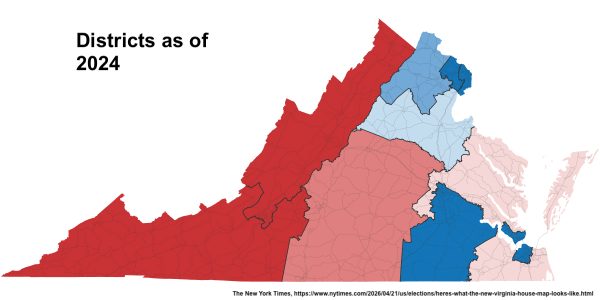
In the wake of the Virginia state “special election” on April 21, the results indicated that HB1384, the redistricting amendment, had won by a narrow margin of 2.9%, or 88,915 votes. For the state of Virginia, this meant that congressional districts would be completely redrawn, and former bipartisan measures discarded. In previous years, Virginia’s districts ensured a near-equal balance between democratic and republican voter bases, as shown by this map.
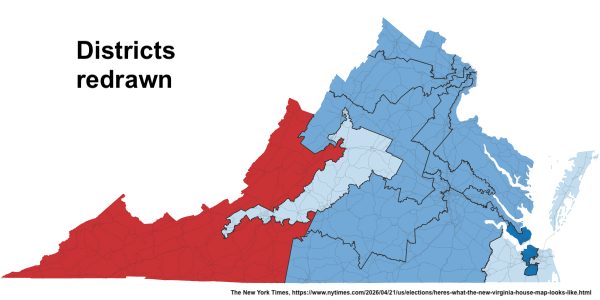
 With the new map drawn by Virginia democrats, however, strong republican areas are split and democratic regions expanded in cleverly devised yet ridiculous extensions. This map shows the proposed districts, which were set to take effect immediately after the April 21 election.
On April 22, however, the decision was blocked by Virginia circuit court Judge Jack Hurley of Tazewell County. Hurley declared that the redistricting bill is “void ab initio” or “illicit from the beginning,” as it violates several key points of the Virginia constitution and Virginia Code. Hurley’s decision has already been appealed by the Virginia Attorney General, and the case will most likely end up in the Supreme Court.
Directly relating to voters and citizens, Hurley gives a prominent reason for why the election results and consequences are illicit. “HB 1384,” writes Hurley’s verdict, “submits to the voters a flagrantly misleading question… ballot language [did] not accurately describe the proposed amendment as it was passed by the general assembly.” This fact, previously pointed out by astute observers, is not easy to discount. The politicians who wrote HB 1384 intended for their measure to pass at any cost, even resorting to an obvious fallacy in order to do so. Concerning the ballot language and every one of his other points, Judge Hurley’s verdict is an overdue public acknowledgement of the unbiased facts of the matter.
The blocking of HB 1384 means that Virginians once again have a chance for fair representation in the state legislature. Additionally, it sheds a clear light on a few of the all-to-common methods of political machination in critical state issues. Most importantly of all, the blocking of HB 1394 seems to indicate that the two additional constitutional amendments proposed for voting this November (a measure to radically redefine marriage and a sanction for unlimited abortion) will have a slimmer chance of passing. HB 1384 may no longer be a threat, and the two bills which would have greatly profited from its passing may, in turn, be defeated.
The moral health of the state of Virginia— and of our nation— is still under attack. The redistricting amendment may no longer be a direct threat, but threats still abound. Echoing the words of Bishop Michael Burbidge of the Diocese of Arlington, Catholics must continue their diligent, dedicated and direct advocacy for truth, life and morality. “Our response,” he wrote in January 2026, “Our response as Catholics—and as citizens committed to justice—must be rooted in faith, truth, and love.” One threat has been quelled, but the battle still rages. Virginia— and the nation— must continue to fight.